ARTISTS
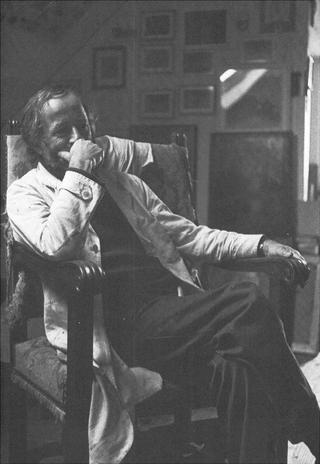
Wyrsch was born in Buochs, Nidwalden in July 1920. His mother died seven days after having given birth on puerperal fever. His father, Carl II Wyrsch, married a second time. From this marriage came eight children. Wyrsch grew up with his grandparents, Carl I and Maria in Buochs. From 1935 to 1938, he was trained as a painter at his father's place. Like his great grand uncle Johann Melchior Wyrsch, he aspired to study in depth art in some of the most prestigious Swiss and French art schools. From 1939 to 1943 he attended the School of Applied Arts in Lucerne.
In the same year Wyrsch left for academic study at the "Ecole des Beaux-Arts" in Geneva. To top off his studies, he was awarded the Prize of the City of Geneva. This price included the use of a studio for a year, five hundred francs and ten days' journey to Paris with art students from all over Switzerland. Back in Switzerland, he took three months private lessons with Albert Pfister in Erlenbach and learned to know the Fauves and the Expressionists.
After this examination favored by Pfister on colors he followed another program at a school of applied arts, this time in Basel with Ernst Buchner and the sculptor Walter Bodmer, with whom he mainly dealt with matters of form. In 1949 he temporarily moved to Paris.
In 1953, he married Edith Hug and settled to Lachen Schwyz. He got his first big orders and successes.
The municipality of Buochs ordered a fresco for the new school building. In the 1950s Wyrsch painted his first series of paintings of the "barons". The elongated faces with hat reminiscent of Modigliani and Utrillo, their paintings he learned during his time in Paris. The turning point in the creative process of Wyrsch took place towards the end of 1950.
Wyrsch's artistic career was based on the expressive of figurative paintings, which he gave up in favor of abstraction for about ten years, to return to the figurative. His motives were selected by Wyrsch from the traditional genus species. He dealt with Velásquez and El Greco and was inspired by contemporaries. But his paintings remain independent and can be assigned to any style. He described himself as a man of the present and was open to everything new. But he suffered from the threat to nature and the loneliness of man. There were issues that he liked to present in his works. In nudes and portraits, including many self-portraits he expressed this suffering, to his person sometimes bluntly.
Wyrsch died in June 2019 at the age of 98.
RELATED PUBLICATIONS
RELATED EXHIBITIONS
READER