TIMELINE
This section traces over 35 years of curatorial activities, 25 years of which Kunz spent as director of 3 different museums, in Lucerne, New York, and Ascona, for which he was responsible for curating, publishing, and production. Over 200 exhibitions and 150 publications are included in his career, many at Biennales, museums, and other spaces, from the Venice Biennial, the Edinburgh International, the Trigon Biennale-Styrian Autumn in Graz, to major museums around the world.
-
1947 Born in Basel

Martin as a child
Born in Basel on October 6th to Gregor N. Kunz - a lawyer with great interest in classical art and a passion for traveling - and Helene Hupfer, whose family had a background in farming and the gravel industry.
continue... -
1957 - 1967: Early education and interests
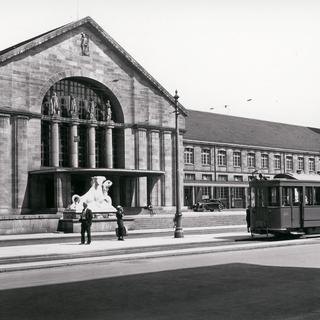
Basel in the 50'
Attends Humanistisches Gymnasium, Basel's historic high school, where he pursues a traditional education with emphasis on Latin and ancient Greek. MK later expands his classic curriculum moving to less prestigious highschool Real Gymnasium to include modern languages next to latin and more science. He develops interest and a passion for contemporary architecture.
continue... -
1970 - 1977: Art history studies in Basel and London
Writings
While enrolled for two semesters, as a research student at the Courtauld Institute in London MK begins to write about contemporary art, initially for the Swiss publications Kunst-Nachrichten and Kunstbulletin, followed by articles for Studio International in London and other international magazines like Kunstforum and Flash Art.
In the late seventies, MK finds a large readership for his essays in Basler Zeitung. His full-page text on Picasso's last exhibition during the artist's lifetime - an unedited presentation of his vast output of the previous two years, shown in Avignon shortly before his death - stands out among many dismissive voices for its sympathetic analysis. Repro Page of Paper.
continue... -
1977 - 1989 Director of the Kunstmuseum Lucerne and Curator of International Exhibition
After being appointed as the successor of Jean-Christophe Ammann in the spring of 1977, MK is confronted with an equally challenging and rewarding situation: Amman - who vacates his director's post in Lucerne in favor of heading the Kunsthalle Basel - leaves behind a high-profile institution with a reputation for cutting-edge contemporary art that is not limited to an international program but also includes emerging Swiss artists and special summer exhibitions in the context of the International Festival of Music, which takes place in the same building.
continue... -
1979 MKs and Françoise’s son, Thomas Bourgeau, is born.
Thomas Bourgeau
Françoise Bourgeau, who has split her time between Switzerland and France since MK’s appointment to lead the Kunstmuseum. However, life in the comparatively provincial city of Lucerne does not suit her, and she moves back to Paris for good shortly before Thomas’ birth. The couple separates.
continue... -
1980 The Venice Biennale and other international exhibitions
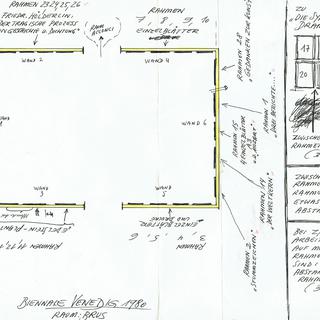
Biennale map 1980
Shortly after taking on his new position at the Lucerne Museum - and not least because of the impact of his Acconci exhibition - the Venice Biennale appoints MK in 1978 as commissioner and curator of the main international exhibit at the Central Pavilion in the Giardini. He is the youngest among his well-established co-curators Harald Szeemann, Michael Compton (from Tate Gallery), and Achille Bonito Oliva who are chosen to collectively organize the main exhibition at the Giardini.
continue... -
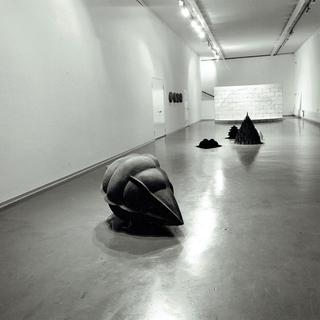
1982 With his survey exhibition "British Sculpture Now" MK introduces emerging artists
Englische Plastik Heute - Kunstmuseum Luzern - 1982
With his survey exhibition "British Sculpture Now" MK introduces emerging artists like Anish Kapoor, Richard Deacon, Bill Woodrow and Steven Cox even before they are shown in London. As an advocate of underrepresented female artists, MK shows Maria Lassnig, Alice Aycock, Astrid Klein, Christa Näher, and Isolde Wawrin throughout the 1980s.There was also a project of participation in a Louise Bourgeois exhibition with Weiermeier in Frankfurt, which was not realized by his successor.
continue... -
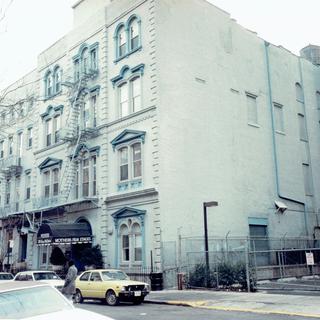
1989 Departure from Lucerne Museum and move to New York
In the winter of 1989 MK leaves the Lucerne Museum and moves to New York where he plans to open a European-style Kunsthalle, a type of exhibition space that he finds lacking in the city's vital art scene. He had to build up the institution with help of European Art Philantropists from scratch. The building which was selected was still in use as a well known, but run down film studio near Cooper Union, the “Mother’s Film stages”, set up an non-for-profit organisation “The New York Kunsthalle”.
continue... -
1993 - 1994 Groundbreaking exhibitions at New York Kunsthalle
Sarajevo Witnesses of Existence - Poster
In its first two years, the New York Kunsthalle mostly presents exhibitions by emerging artists who in many cases are inspired by the ruin itself or by the traces and left overs from the film studio. Quite a few of them eventually appear in biennials and established New York institutions.
Among those are Nancy Rubins, Dan Peterman, Kirsten Mosher and Sonia Labouriou, who are represented in the 1993 exhibit Enclosure - it goes up while construction work on the building is still in progress, and the equipment is used for some of the large scale installations.
continue...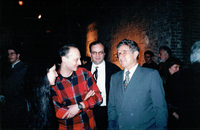
-
1994 - 1995: Intensive renovations, including a new roof, take place
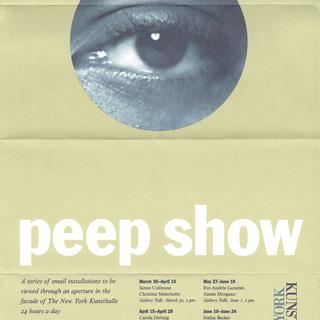
Peep Show - The New York Kunsthalle
Intensive renovations, including a new roof, take place. During that period, the two storefronts of the building, which are accessible from East Fifths Street, are used as exhibition spaces: a small jury of well-known New York art critics, artists, and curators selects 36 participants to show their work for an extended amount of time.
continue...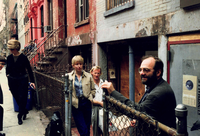
-
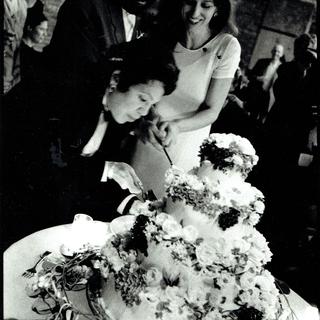
1997 MK and Linda Salerno marry
MK and Linda Salerno get married
MK and Linda Salerno marry. The painter and photographer, who grew up in Harrisburg, Pennsylvania as an only child of Southern Italian immigrants, had moved to Soho in the early 1970s and became deeply connected to the downtown artist community. In her large-scale paintings, she often worked with found images embedded in layers of paint and experimented with inventive techniques.
continue...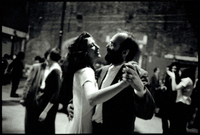
-
1997 Leon Golub
Leon Golub - New York 1987 - Card (front)
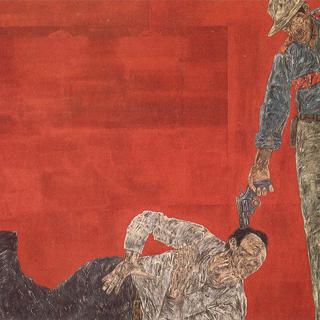
Leon Golub, whose powerful tableaux of human cruelty and suffering MK was the first to present in a museum on the European continent in 1987 in Lucerne and Hamburg newer paintings of the ‘70and ‘80. In New York Golub showed his earlier exhibits, works from his intense series Shields and Gigantomachy of the late ‘60 and ‘70.
Exact dates in 1997 But the critical success of this and previous shows alone cannot carry the Kunsthalle, and MK is forced to announce the closing of his non-profit in the near future.
continue... -
2000 - 2003 Exhibitions and events at the former Kunsthalle, now Beethoven Hall
Qiu Shia Hua - Artwork
MK and Linda Salerno move into their loft on the top floor of the former Kunsthalle. LS transfers the content of her Soho studio of 30 years to the East Village and shows her paintings in the grand project room with its fifteen-meter ceiling adjacent to the couple's living quarters.
continue... -
2002 Linda Salerno is diagnosed with a serious illness
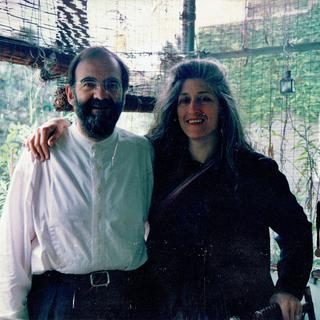
MK and Linda Salerno
Linda Salerno is diagnosed with a serious illness and the couple decides to move to Someo in the Ticino, where MK owns a house and superior health care is available. The 19th MK has been writing most of his catalogue texts since 1980, and there is room for a painting studio.
continue... -
2005 Return to Switzerland
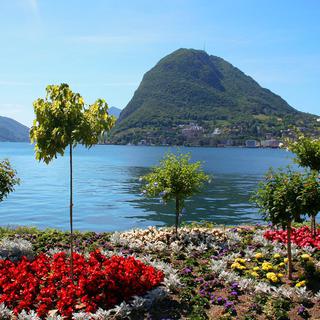
Lugano (Switzerland)
MK and LS sell their share of Beethoven Hall and move permanently to Switzerland. They acquire an additional building in Lugano for closer proximity to medical facilities.
continue... -
2005 - 2007: Director of the Ascona Museum of Modern Art
Photo Suisse poster (front)
MK becomes director of the Ascona Museum of Modern Art. Part of his mission requires the supervision of the creation of a new museum structure within a planned music and art Center - the project is never realized.
continue...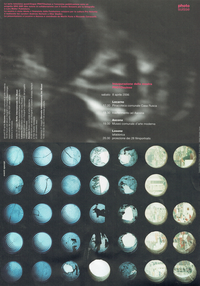
-
2007 - 2009 Founding of K10-Kunzarchive
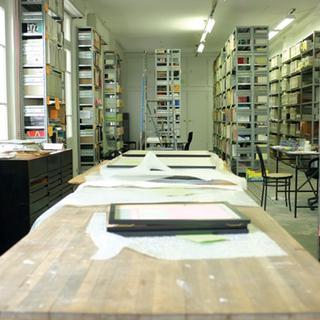
K10-Kunzarchive
MK oversees the scholarly organization of his library of about 20,000 art books, catalogues and bibliophile items, which have traveled back to Switzerland from New York. He lays the groundwork for the eventual opening of K10-Kunzarchive as a semi-public research and exhibition space. Parallel to these efforts MK also converts a former Coop supermarket that LS has discovered in Bedano - a northern part of Lugano - into a studio and exhibition space for her.
continue...